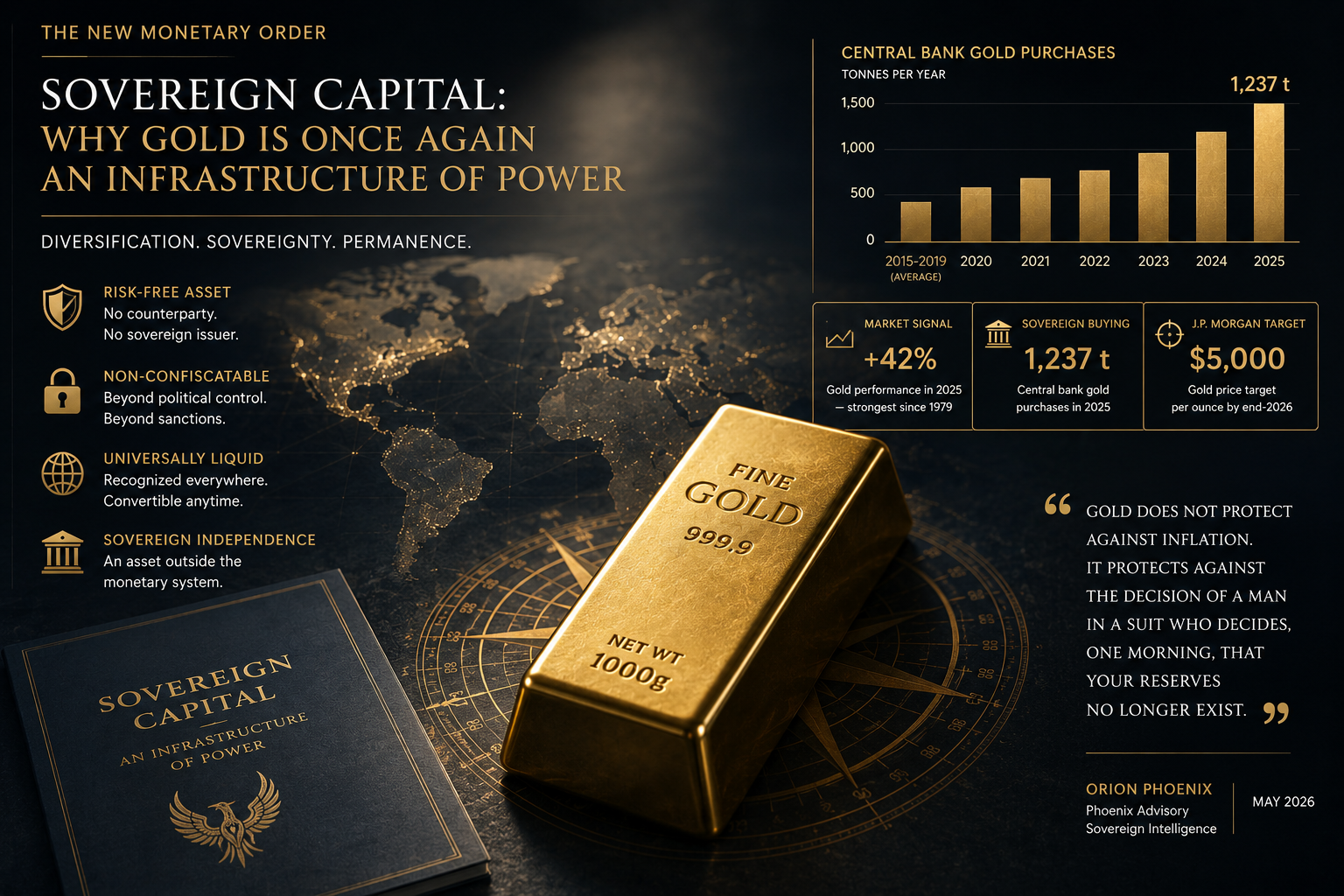
SOVEREIGN CAPITAL: WHY GOLD IS ONCE AGAIN BECOMING AN INFRASTRUCTURE OF POWER
Sovereign Capital:
why gold is once again
an infrastructure of power
Sovereign capital is not the capital that performs inside consensus. It is the capital that survives when monetary consensus begins to fracture.
I. The Blind Spot
Consensus still treats gold as a hedge. An insurance policy. A passive asset designed for unstable periods. That framework is obsolete. It belongs to a world in which the dollar still functioned as an unquestioned monetary axiom.
What has unfolded since 2022 is not a rally. It is a structural reclassification of gold as sovereign infrastructure capital. Forty central banks are accumulating simultaneously. China continues to buy quietly — outside official reporting channels since May 2024. India, Turkey, and Poland are expanding reserves aggressively. This does not resemble a conventional market cycle. It resembles coordinated geopolitical repositioning.
The signal is not in the price. The signal is in the motivation.
II. Systemic Rupture
February 2022. Washington and Brussels freeze $300 billion in Russian reserves. In a single decision, they transmit an unmistakable message to every non-aligned central bank on earth: dollar reserves are politically confiscable. This moment marks what strategists define as a systemic trust rupture.
Gold yields nothing. That is precisely why it becomes strategic again. It has no sovereign issuer. It cannot be frozen. It depends on no Western settlement infrastructure. In a world where the dollar is progressively transforming into an instrument of geopolitical coercion, gold becomes the only non-sovereign reserve asset with global liquidity.
BRICS+ nations now hold 17.4% of global gold reserves, versus 11.2% in 2019. This is not portfolio diversification. It is geopolitical rebalancing.
When capital stops chasing yield, it runs toward permanence. And permanence is gold.
III. The Mechanics of Monetary Fragility
The dollar is losing ground. Not through collapse — its depth and liquidity remain unmatched — but through slow structural erosion. Its share of global reserves has declined from 71% in 2001 to roughly 58% today. U.S. fiscal deficits continue to expand. Negative real yields persist. The Federal Reserve cut rates three consecutive times in late-2025 amid rising unemployment and slowing growth.
This environment is generating something markets still struggle to define precisely: a Silent Devaluation. Not an officially declared devaluation — Washington would never frame it that way — but a progressive depreciation driven by contradictory policies: explosive deficits, compressed real yields, institutional uncertainty, and dollar weaponization.
Gold is responding to this fragmentation. It is not outperforming despite high rates — it is outperforming with high rates, a structural signal not seen since the 1970s. The traditional correlation between opportunity cost and gold pricing has broken. The market is communicating something conventional models still fail to integrate.
IV. Sovereign Repositioning
Gold is not merely an inflation thesis. That framing is too narrow. It is a thesis of patrimonial sovereignty — the ability of a state, institution, or individual to maintain reserves beyond the reach of unilateral political decisions.
For wealth managers operating across jurisdictions, this changes portfolio architecture fundamentally. Gold should not be evaluated through risk-adjusted return metrics alone. It should be evaluated through resilience under dislocation scenarios: sovereign debt crises, bond market closures, settlement fragmentation, or multipolar monetary realignment. In each of those scenarios, gold preserves where conventional assets fail.
J.P. Morgan projects $5,000 per ounce by end-2026. Amundi targets $5,000 by 2028. Goldman Sachs sees $5,000 as increasingly probable if the Federal Reserve weakens further. These projections converge not because of speculative euphoria, but because sovereign flows are creating a structural price floor — estimated between $4,500 and $4,600 — where institutional buyers become aggressively active.
This floor does not behave like technical support. It behaves like policy.
Gold does not protect against inflation.
It protects against the decision of a man in a suit who wakes up one morning and decides that your reserves no longer exist.